Tire Replacement Near Me
Tire Replacement Near Me
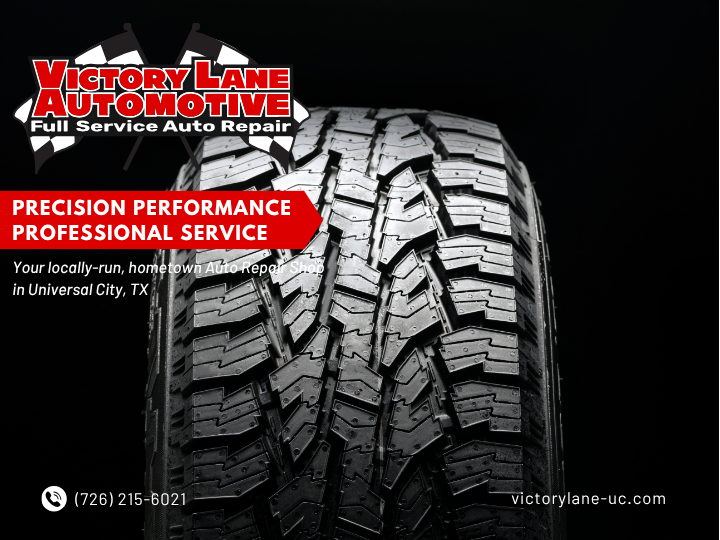
When "Tire Replacement Near Me" Is the Most Important Search You Will Make This Year
Most searches start with a feeling, not a fact.
You notice something slightly off in the way your vehicle handles on the morning commute. A faint pull to one side when you release the steering wheel heading west on Pat Booker Road toward the I-35 corridor. A vibration through the floorboard at highway speed that was not there a few months ago. You crouch down in a parking lot and look at your front tires and something in your gut tells you what your brain does not want to acknowledge yet. Or maybe you had a close call — a near-slide on a rain-slicked road during one of San Antonio's sudden summer thunderstorm events, a stopping distance that felt longer than it should have — and you drove home quieter than usual.
Whatever brought you here, you typed tire replacement near me because something already told you it was time.
That instinct is worth listening to. And the decision that follows — which shop you trust, how thoroughly they evaluate your situation, whether you walk away with honest information or a fast transaction — matters far more than most drivers ever stop to consider.
This blog is written for drivers in Universal City, Texas and throughout the surrounding communities of Schertz, Converse, Randolph AFB, Live Oak, Selma, Seguin, Marion, Cibolo, and across the northeast San Antonio metro corridor. It is written not to sell you a set of tires, but to give you the education you deserve — so that when you make this decision, you make it with complete clarity and confidence.
The Foundation of Every Safety System on Your Vehicle
Engineers invest billions of dollars designing braking systems, traction control, electronic stability programs, lane departure warnings, and collision mitigation technology. Modern vehicles are remarkable machines. But every single one of those systems — every algorithm, every sensor, every safety innovation — delivers its results through four contact patches of rubber pressed against the road.
Four patches. Each one roughly the size of your open hand.
That is the physical reality of vehicle safety. Your tires are not a peripheral component or a routine wear item to be addressed when convenient. They are the final output of everything your vehicle is engineered to do. When you brake hard to avoid a collision, it is the tire that either holds or slips. When your stability control system intervenes in a sudden swerve, it is the tire that provides or fails to provide the grip the system needs to work. When you drive through standing water on Kitty Hawk Road or navigate the flooded low-water crossings that appear on the secondary roads throughout Guadalupe and Bexar Counties after a heavy South Texas thunderstorm, it is the tread pattern on your tires — or the absence of it — that determines whether you stay planted or lose control.
No technology compensates for a worn, degraded, or structurally compromised tire. That is not opinion. That is physics.
And in the northeast San Antonio metro corridor, where summer heat reaches some of the most aggressive tire-aging temperatures in the country, where sudden and violent thunderstorms drop enormous amounts of rain in very short periods of time, where the road network carries a mix of heavy military installation traffic, dense suburban commuter volume, and the highway loads of one of Texas's fastest-growing regional corridors — the condition of your tires is not a seasonal concern. It is a permanent one.
Why So Many Drivers Put Off Tire Replacement Longer Than They Should
This is not a judgment. It is an honest conversation about something most drivers experience at some point.
Tires are not inexpensive. For families throughout Universal City, Schertz, Converse, Live Oak, Cibolo, and the surrounding communities — many of them military families managing the financial realities of service life — an unexpected tire replacement can represent a real financial disruption. The instinct to extend a set of tires a little further is completely understandable and entirely human.
Tires also wear slowly enough that the change is nearly imperceptible from one day to the next. You drove on 5/32nds of tread yesterday and you are driving on 3/32nds today and nothing felt catastrophically different this morning. The degradation is gradual. The loss of safety margin is not always felt until a moment arrives that demands everything your tires have left — and they come up short.
There is also a trust problem in the auto repair industry that has made many drivers appropriately skeptical. Shops that lead with price pressure, that hand you a quote before they hand you a real explanation, that treat the transaction as the objective rather than your safety — those experiences leave people reluctant to seek service until they absolutely have no choice. Military families who move frequently and need to quickly establish trust with a new local shop understand this challenge better than most. If you have ever walked away from a shop feeling like you were processed rather than genuinely served, you are not alone.
The answer is not to delay necessary tire replacement. The answer is to find a shop that earns your confidence before it ever asks for your business.
What a Genuine Tire Evaluation Looks Like
When a shop takes your tire condition seriously, they are doing far more than running a gauge across the center of the tread and handing you a number. A thorough tire evaluation is a diagnostic process. It reveals information not just about your tires but about your vehicle's alignment health, suspension condition, inflation history, and the driving patterns that have shaped how your tires have worn over time.
Here is what that evaluation should include:
Tread Depth Measured at Multiple Points Across Every Tire
The center channel, the inner shoulder, and the outer shoulder of each tire should all be measured independently. The pattern that emerges from those three data points per tire tells a story that a single center measurement never can.
Wear concentrated in the center of the tread indicates chronic overinflation — the tire is riding on its center because the sidewalls are carrying too much pressure and the center crown is bearing disproportionate load. Wear on both outer shoulders indicates chronic underinflation — the tire is collapsing under load and making excessive contact at its edges. Wear concentrated on one shoulder indicates a camber or alignment problem pulling the tire onto that edge. Cupping, scalloping, or feathering across the tread surface indicates worn or failing suspension components — shocks, struts, or control arm bushings allowing the wheel to bounce rather than maintain consistent, controlled contact with the road surface.
A technician who reads only the center measurement and gives you a pass or fail answer is not providing a complete assessment. The pattern of wear is as diagnostically important as the depth of what remains on the tire.
Tire Age and Rubber Compound Integrity
Every tire manufactured for the United States market carries a DOT code molded into the sidewall. The last four digits represent the week and year of manufacture. A tire built in the 28th week of 2019 carries the code 2819.
Rubber compounds degrade over time regardless of how much tread remains. UV exposure, ozone, heat cycling, and age combine to break down the molecular structure of the tire — a process that accelerates meaningfully after approximately six years and becomes a genuine structural concern by eight to ten years regardless of how the tire appears on the surface.
In Universal City and the northeast San Antonio metro corridor, the combination of intense South Texas UV radiation, extreme summer heat, and the thermal stress of driving on sun-baked pavement through one of Texas's hottest urban environments creates one of the most aggressive tire-aging climates in the continental United States. San Antonio and the surrounding Bexar and Guadalupe County communities regularly experience triple-digit summer temperatures, and pavement surface temperatures during a July or August afternoon exceed air temperature by thirty to forty degrees or more. A vehicle parked outdoors in Universal City during a Texas summer is subjecting its tires to conditions that compress the aging timeline significantly beyond what the calendar alone would suggest.
This is why age-based tire evaluation is critically important for drivers in this region. A tire that might reliably serve a driver in a cooler northern climate for eight years may reach its practical structural limit in five or six years in the South Texas heat environment. Sidewall cracking, surface checking, and dry rot are the visible indicators of this process. Internal micro-fracturing within the carcass is not visible but is equally real. A shop that genuinely has your best interest at heart will tell you this, even when the conversation requires more than a quick tread depth measurement.
Structural Integrity — Sidewalls, Belts, and Bead
Bulges, bubbles, and deformations on a tire's sidewall indicate internal belt separation. This is not a condition that progressively worsens at a predictable rate. It is a condition that precedes sudden, complete structural failure — a blowout — often at the worst possible moment: highway speed on I-35 or I-10 in heavy San Antonio metro traffic, a loaded truck or SUV on a rural Guadalupe County road, a flooded surface after a thunderstorm.
The roads throughout the northeast San Antonio corridor create structural stress on tires in ways specific to this region. The expansion joint impacts on elevated sections of I-35 and Loop 1604, the pothole damage that accumulates on surface streets throughout Universal City, Converse, and Live Oak following Texas's occasional hard freeze events, the rough pavement on portions of Pat Booker Road, Kitty Hawk Road, and the secondary roads connecting Schertz, Cibolo, and Marion to the regional highway network — impact damage from these conditions can cause internal belt damage that produces no immediate symptom and no visible external evidence. A tire that absorbed a significant impact on the I-35 approach may look fine in the driveway a week later and display a sidewall deformation two weeks after that. The damage was done at the moment of impact.
A proper inspection includes careful examination of every sidewall, every shoulder, and the bead zone where the tire seats against the rim on every tire on the vehicle.
Inflation Assessment and TPMS Verification
Tire pressure monitoring systems became federally required on all passenger vehicles sold in the United States after 2007. But the dashboard warning light is a lagging indicator — it activates after pressure has already fallen below a defined threshold. It does not tell you that pressure is trending downward or that one tire is consistently running lower than the others.
In South Texas's climate, tire inflation is affected by temperature variation in ways that are more dramatic than most other regions in the country. Tire pressure drops approximately one PSI for every ten-degree drop in ambient temperature and rises proportionally with heat. A tire properly inflated during a cool January morning in Universal City will read significantly higher on a 105-degree August afternoon sitting in the Randolph AFB parking lot — and the reverse is equally true. The enormous seasonal and even daily temperature swings of South Texas create tire inflation variation that drivers here should understand and monitor more proactively than drivers in more temperate climates.
TPMS sensors are also battery-powered electronic components with a defined service life. The heat environment of South Texas accelerates battery degradation in TPMS sensors in ways that shorten their practical service life. When a sensor fails silently, the driver receives no warning when pressure drops. Confirming every sensor is functional is part of a complete tire evaluation and should never be treated as optional.
Matching and System Integrity
Your four tires work as a system. Mismatched tires — different brands with incompatible tread patterns, tires in significantly different stages of wear, or tires that deviate from the vehicle's specified size, load index, or speed rating — create handling imbalances that affect braking distances, lateral stability, and emergency maneuver behavior.
Trucks and large SUVs are the dominant vehicle platform throughout the northeast San Antonio market — the military community around Randolph AFB, the working families of Schertz, Cibolo, and Marion, and the outdoor and recreation-oriented households of this part of Texas all trend heavily toward truck and SUV platforms that carry specific load index and size requirements. Matching tire specifications correctly to these vehicles is not a minor technical detail. It is a fundamental safety requirement. A complete evaluation assesses all four tires as an integrated system and delivers an honest picture of whether they are working together effectively or creating compounding problems.
The Alignment Conversation That Should Never Be Skipped
This deserves its own section because it is the most commonly bypassed element of the tire replacement process — and bypassing it is one of the most quietly expensive mistakes a driver can make without realizing it until significant damage has already been done.
When tires are installed on a vehicle that is out of alignment, uneven wear begins immediately. Not gradually over the first several months. Immediately, from the very first mile. The same misalignment that was slowly consuming your previous tires begins consuming your new ones the moment they contact the road surface.
Wheel alignment — specifically the camber, caster, and toe geometry of each wheel — governs how your tires make contact with the road. When those angles are within specification, your tires wear evenly across the full tread width and your vehicle tracks straight and true without constant steering correction. When those angles drift out of specification — through road impact, through accumulated suspension component wear, through the normal settling of chassis geometry over time and miles — your tires begin to scrub unevenly and your vehicle begins to pull, wander, or feel vague and imprecise in its steering response.
The road network throughout the northeast San Antonio corridor creates alignment challenges that are specific and worth understanding. The combination of heavy traffic volume on I-35, Loop 1604, and the surface road network connecting Universal City, Schertz, Converse, and Live Oak, the pavement stress from Texas's thermal cycling between extreme summer heat and the occasional hard freeze, and the road damage that accumulates on the secondary routes connecting the suburban communities to the regional highway network — all of these create alignment-affecting road events that drivers throughout this corridor encounter with regularity. Texas roads bear heavy loads from truck traffic, and the surface deterioration that comes with that load creates more alignment-affecting impacts than many drivers realize.
A shop with your best interest at heart raises the alignment conversation during every tire replacement service. Not as an upsell. As a professional responsibility. Because replacing tires without addressing alignment is, in too many cases, the beginning of a cycle that ends with you replacing those tires far sooner than you should have to.
South Texas Heat and What It Actually Does to Your Tires
This section deserves direct and focused attention because the climate of the northeast San Antonio metro area is genuinely one of the most demanding tire environments in the country, and most drivers do not fully understand the implications.
Extreme Heat and Accelerated Aging
South Texas summer heat is not simply uncomfortable. For tires, it is genuinely destructive in ways that accumulate invisibly over time. The combination of ambient air temperatures regularly exceeding 100 degrees, pavement surface temperatures that can reach 150 degrees or higher, and the thermal cycling that comes with driving in these conditions and then parking in direct sun creates rubber compound stress that no tire is immune to.
The practical result for drivers in Universal City, Schertz, Converse, and the surrounding communities is that the tire aging timeline is compressed. A tire that might last eight years in Minnesota may reach structural compromise in five years in South Texas. Drivers who do not accumulate high annual mileage — retired military personnel, part-time drivers, households with multiple vehicles — are particularly at risk for age-based tire failure because their tires reach the structural age limit before the tread depth limit. A tire with 6/32nds of tread that is eight years old in San Antonio is a tire that needs honest evaluation, not a tread depth pass.
Sudden and Violent Thunderstorms
The Texas Hill Country and San Antonio metro area are positioned in a region that receives some of the most intense convective thunderstorm activity in North America. Summer storms in the northeast San Antonio corridor can drop several inches of rain in less than an hour, overwhelming drainage infrastructure and creating standing water and flooded roadways on Kitty Hawk Road, Pat Booker Road, and the secondary roads throughout Guadalupe and Bexar Counties with very little warning.
Hydroplaning — the condition where a tire rides on a film of water rather than maintaining contact with the road surface — occurs when tread pattern design and depth cannot channel water away from the contact patch fast enough at the vehicle's current speed. The faster the vehicle and the shallower the tread, the lower the speed threshold at which hydroplaning begins. On a Texas summer road flooded by a sudden thunderstorm, the difference between adequate tread and worn tread is the difference between maintaining control and losing it entirely.
Freeze Events and Rapid Temperature Swings
While South Texas winters are mild compared to northern states, the region experiences hard freeze events with enough frequency to matter. When those events arrive, they often arrive rapidly — temperatures that drop from comfortable to freezing within hours, catching drivers on roads that have not been pretreated and tires that have been performing in warm-weather conditions. The rapid temperature drop that stiffens all-season tire rubber compounds and the ice formation on bridge decks and shaded road sections on I-35, Loop 1604, and the local surface road network creates genuinely dangerous conditions that tire condition directly affects.
Understanding Tire Categories Without the Sales Pressure
The tire market is vast and the range of products available spans an enormous spectrum of quality, capability, and price. Here is an honest framework for thinking through your options as a northeast San Antonio corridor driver.
All-Season Tires
The most appropriate baseline choice for the majority of Universal City and surrounding community drivers for everyday passenger vehicles and crossovers. All-season tires perform reasonably well across the conditions most drivers here encounter — dry summer pavement, wet storm conditions, and the occasional winter event. Within the all-season category, wet-weather braking performance varies meaningfully between tire lines. In a region where sudden violent thunderstorms create the most dangerous driving conditions most drivers will ever encounter, wet traction performance within the category is a significant safety consideration.
Performance All-Season Tires
Designed for vehicles with sportier handling characteristics — performance sedans, coupes, and crossovers with larger wheel packages. These tires prioritize enhanced dry and wet grip at the cost of some tread longevity. In South Texas's driving environment, where dry road performance dominates for most of the year and wet-weather performance matters intensely during storm events, these tires make sense for the right vehicle and driver combination.
All-Terrain Tires
Highly relevant for the northeast San Antonio market, where trucks and large SUVs dominate and where the terrain variety — from urban highway driving to the rural roads and ranch access routes throughout Guadalupe County, the Hill Country approaches west of San Antonio, and the outdoor recreation destinations accessible from this corridor — makes traction versatility a practical priority. All-terrain tires offer increased capability on unpaved and loose surfaces at the cost of some road noise and modest fuel economy impact on pavement.
Mud-Terrain Tires
Relevant for working trucks and off-road-oriented vehicles that regularly operate on the ranch roads, hunting leases, and rural terrain accessible from the northeast San Antonio and Guadalupe County area. Mud-terrain tires are purpose-built for aggressive off-road traction in mud, rock, and loose terrain at the cost of meaningful road noise and reduced on-pavement handling refinement. The right tool for the right application.
Highway Terrain Tires
A category that bridges the gap between standard all-season tires and all-terrain tires for truck and SUV drivers who want more capability than a standard all-season provides but spend the majority of their miles on paved roads. Common on work trucks and large SUVs in the San Antonio market where the vehicle is primarily a highway and surface road tool with occasional light off-road or towing use.
Load-Rated Commercial Tires
Specific to trucks and vans operating under increased load requirements — particularly relevant in the Universal City and Schertz market where working trucks in construction, trades, and military-adjacent service industries carry loads that standard passenger tire load indexes cannot safely support. Load index must be matched precisely to the vehicle's operational requirements without compromise.
The right tire for your vehicle is not determined by what is on sale. It is determined by your vehicle's engineering specifications, your driving patterns, the specific roads and terrain you regularly navigate, and an honest conversation with a technician who understands all of those factors and gives you a straight answer.
What Professional Tire Installation Actually Includes
The quality of a tire installation is invisible when you drive away from the shop. It reveals itself in the weeks and months that follow — in how evenly your tires wear, in whether vibration develops, in whether your valve stems maintain pressure through Texas's extreme temperature swings, in whether your lug nuts hold proper torque. In some cases it reveals itself suddenly and with serious consequences.
Here is what professional installation genuinely includes:
Proper Mounting Technique
Directional tires must be mounted with rotation direction observed. Asymmetric tires must be mounted with the designated outboard side correctly positioned. The bead must be fully and evenly seated against the rim before inflation — incomplete bead seating causes slow leaks, handling inconsistencies, or sudden separation under load. These are fundamental requirements of a correctly executed installation.
Calibrated Wheel Balancing
Wheel and tire assemblies are balanced using computerized equipment that identifies mass imbalances around the assembly's rotational axis and directs the correct placement and quantity of corrective balance weights. An assembly that is out of balance transmits vibration through the steering column and floorboard at specific speed ranges — uncomfortable for the driver and progressively damaging to steering components, wheel bearings, and suspension bushings over accumulated miles.
Valve Stem Replacement
Rubber valve stems are serviceable wear components with a defined service life that is significantly accelerated by the UV intensity and heat of South Texas's climate. Installing new tires on deteriorated rubber valve stems is a false economy that creates the conditions for sudden, unexpected pressure loss without warning. In a region where summer heat already stresses every rubber component on a vehicle, this is not a shortcut any professional shop should take. New valve stems with every tire replacement. Without exception.
Torque-to-Specification Lug Nut Installation
Lug nuts must be tightened to the vehicle manufacturer's specified torque using a calibrated torque wrench — not an impact gun set to whatever level moves the work through quickly. Under-torqued lug nuts can allow wheel movement under load. Over-torqued lug nuts warp brake rotors and create unnecessary difficulty at future service intervals. Proper torque is a precise specification that requires the right tool applied correctly every time.
TPMS Reset and Full Sensor Verification
After new tires are mounted, every TPMS sensor must be confirmed functional and relearned to the vehicle's control module. In South Texas's heat environment, where TPMS sensor battery life may be shorter than in cooler climates, verifying sensor function is particularly important. Skipping this step leaves the driver without a functioning pressure warning system at exactly the time of year — summer — when tire inflation management matters most.
Road Test and Final Verification
A properly mounted and balanced tire rolls smoothly at all speeds with no vibration transmitted through the steering column or floorboard. Any vibration present after installation must be identified and corrected before the vehicle is returned to the customer. This requires actually driving the vehicle at speed — not simply rolling it out of the bay and confirming the wheels are round and attached.
Serving Universal City and the Full Northeast San Antonio Metro Corridor
The driving environment throughout this region creates specific and meaningful demands on tires and on the shops responsible for maintaining them.
Universal City sits at the heart of the northeast San Antonio military and suburban corridor — positioned along Kitty Hawk Road and Pat Booker Road with direct access to the Randolph AFB community and the broader residential network connecting the military installation to the regional highway system. The mix of military family households, civilian commuters, and the working-class community that surrounds one of Texas's most significant air force installations creates a diverse driver population with equally diverse vehicle and tire needs.
Schertz has grown rapidly into one of the most significant suburban communities in the northeast San Antonio corridor — a community that generates substantial daily commuter traffic on I-35, FM 3009, and the local arterials connecting its expanding residential neighborhoods to San Antonio employment centers and the regional highway network. The road demands of a rapidly growing community include both new construction zone surfaces and the established arterials that carry increasing load as population grows.
Converse drivers navigate the dense surface road network connecting this established community to the I-35 and Loop 1604 corridors — urban commuting conditions on roads that carry the demands of a community that has grown substantially faster than its road infrastructure in some areas.
Live Oak sits directly on the I-35 corridor, with drivers who experience both the high-speed demands of interstate commuting and the stop-and-go conditions of one of the most commercially active stretches of highway in the northeast San Antonio market.
Selma drivers occupy a strategic position at the intersection of I-35 and Loop 1604 — one of the busiest highway junctions in the San Antonio metro — and navigate both the freeway demands of that position and the surface road conditions of a rapidly growing commercial and residential community.
Cibolo and Marion represent the semi-rural and rural fringe of the northeast San Antonio corridor — communities where the mix of suburban commuting and the rural road conditions of Guadalupe County creates a tire requirement profile that combines highway performance demands with the structural durability needs of unpaved and rough surface driving.
Seguin drivers to the northeast anchor the Guadalupe County side of this regional corridor — a community with its own established employment base and the daily commuting patterns that connect it to San Antonio, Schertz, and the regional highway network along I-10 and the secondary road system.
Every community in this corridor deserves access to a shop that understands the specific demands of northeast San Antonio metro driving and approaches tire replacement with the thoroughness and honesty that your safety genuinely requires.
The Shop That Puts Your Safety First
Victory Lane Automotive, located at 264 Kitty Hawk Rd, Universal City, Texas, understands the driving environment of the northeast San Antonio corridor because they are part of it. They serve the same roads their customers drive. They understand what South Texas heat, sudden thunderstorms, military family driving demands, and the variety of vehicles that populate this market actually mean for tire safety, longevity, and honest evaluation.
When you bring your vehicle to Victory Lane Automotive, you receive a genuine inspection before you receive a recommendation. You receive an honest explanation of what your tires show, what the wear patterns indicate about your vehicle's broader condition, and what your actual options are — presented clearly, completely, and without pressure. The alignment conversation happens because it should. Your valve stems are replaced. Your lug nuts are torqued to the manufacturer's specification with a calibrated wrench. Your TPMS sensors are verified functional and properly reset. And your vehicle is driven, not simply rolled out of the bay, before it is returned to you.
Victory Lane Automotive serves Universal City and the full northeast San Antonio metro corridor — Schertz, Converse, Randolph AFB, Live Oak, Selma, Seguin, Marion, Cibolo, and beyond — as a shop committed to the belief that your safety is not a sales opportunity. It is a responsibility that begins the moment you trust them with your vehicle.
When your search for tire replacement near me leads you here, you will leave with more than new tires. You will leave with confidence — knowing your vehicle is genuinely ready for every road ahead, from Kitty Hawk Road to the Texas Hill Country and every mile of South Texas in between.
Call (726) 222-1264 or visit victorylane-uc.com to schedule your tire inspection and replacement service today.
You can watch the video