Dealership Alternative Auto Repair Near Me
Dealership Alternative Auto Repair Near Me
Dealership Alternative Auto Repair in Universal City, TX: Why Doing the Work Right the First Time Matters
When a vehicle needs maintenance or repair, many drivers automatically consider returning to the dealership. The dealership may have sold the vehicle, completed its earliest services, and created the impression that only a factory-affiliated service department can care for it correctly.
That is not necessarily true.
A qualified independent auto repair shop can provide the diagnostic equipment, technical knowledge, quality parts, professional training, and skilled workmanship required to maintain and repair today’s vehicles. The right local shop can also provide something that may be difficult to find in a large dealership environment: a continuing relationship with people who know the customer, understand the vehicle’s history, and care about the long-term result.
The most important question is not whether the building says “dealership” or “independent repair shop.”
The most important question is whether the people working on the vehicle are committed to diagnosing the concern accurately, explaining it clearly, completing the entire repair procedure, and verifying that the original problem has been corrected.
A repair that is misdiagnosed, rushed, incomplete, or poorly communicated can cost substantially more than the first visit suggests. The customer may face another diagnostic appointment, additional labor, unnecessary parts replacement, towing, transportation complications, missed work, interrupted family responsibilities, and the frustration of returning with the same unresolved concern.
A true dealership alternative in Universal City, Texas, should not simply be another place to take a vehicle. It should provide a better ownership experience built around accuracy, accountability, transparency, professional workmanship, and truly having the customer’s best interest at heart.
Why Universal City Drivers Look for a Dealership Alternative
Drivers in Universal City depend on their vehicles for work, school, military responsibilities, medical appointments, shopping, family activities, and travel throughout the greater San Antonio area.
Some drivers make frequent short trips around Universal City, Live Oak, Selma, Converse, or Schertz. Others commute into San Antonio, travel through Cibolo, or drive regularly near Joint Base San Antonio-Randolph. Many drivers combine local streets, crowded intersections, highway travel, construction zones, and stop-and-go traffic during the same day.
Each type of driving affects a vehicle differently.
Short trips may prevent the engine and fluids from reaching full operating temperature. Stop-and-go traffic creates repeated braking, acceleration, idling, and heat. Highway driving adds mileage quickly. Texas summer temperatures place additional demand on batteries, tires, cooling systems, air-conditioning systems, belts, hoses, and fluids.
Road construction, uneven pavement, potholes, curbs, and road debris can also affect tires, wheels, steering, suspension, and alignment.
Because every customer uses a vehicle differently, professional auto repair should never be treated as a one-size-fits-all transaction.
Many drivers begin searching for a dealership alternative because they want:
- Clear explanations
- A consistent service advisor
- Accurate diagnostics
- Help prioritizing repairs
- A complete vehicle inspection
- Quality replacement parts
- Convenient scheduling
- A practical maintenance plan
- Confidence that the repair is complete
- A long-term relationship with a local repair team
These are not merely conveniences. They can directly influence the quality of the repair and the customer’s ability to make an informed decision.
Quick Tip: Ask the repair shop how it organizes its recommendations. A professional shop should clearly separate immediate safety concerns, developing reliability issues, maintenance needs, and conditions that can be monitored.
The Dealership Name Does Not Guarantee the Correct Result
Many dealerships employ talented technicians and experienced service advisors. There are also situations in which the dealership may be the correct choice, including certain recalls, factory warranty repairs, manufacturer campaigns, restricted security procedures, and specialized programming.
However, the manufacturer’s name on the building does not automatically guarantee that every concern will be diagnosed correctly or that every repair will be completed perfectly.
Every service facility depends on people, procedures, communication, scheduling, equipment, training, and accountability.
A technician may receive limited time to investigate an intermittent concern. A service advisor may be responsible for many customers at once. Important information may be lost as the repair order moves between the customer, advisor, dispatcher, technician, parts department, and cashier.
A symptom may be addressed without identifying the underlying cause.
The same weaknesses can exist at an independent repair shop. That is why the type of building should never be the only deciding factor.
The deciding factor should be the process the shop follows.
A professional repair process includes:
- Listening carefully to the customer
- Documenting the concern accurately
- Reviewing relevant vehicle history
- Inspecting the vehicle
- Confirming the symptom
- Testing the affected system
- Identifying the actual cause
- Explaining the findings clearly
- Prioritizing the recommendations
- Receiving the customer’s authorization
- Completing the full repair procedure
- Verifying the result
When one or more of these steps are skipped, the possibility of a repeat visit increases.
The Real Cost of an Incorrect Diagnosis
Many expensive repair experiences begin with an incorrect diagnosis.
A warning light appears, the vehicle begins running poorly, a noise develops, or a system stops working. Someone identifies the first component that appears connected to the symptom and recommends replacing it.
The part is installed, but the problem remains.
The customer is then told that another component may also be responsible. A second repair is authorized. If the concern continues, additional parts may be suggested.
This approach is commonly called parts swapping. Instead of testing the system and confirming the failure, components are replaced until the problem disappears.
That can cost far more than investing in professional diagnosis at the beginning.
Consider a check engine light. A diagnostic trouble code normally indicates that a monitored system or operating condition is outside its expected range. Reading the code provides useful direction, but the code alone may not identify the underlying cause. EPA materials describe diagnostic trouble codes as information about system or component malfunctions, which technicians must evaluate as part of a larger diagnostic process.
The actual cause could be:
- A damaged wire
- A poor electrical connection
- A vacuum leak
- A mechanical problem
- A sensor failure
- An exhaust leak
- A fuel-delivery concern
- A software issue
- Another component affecting the same system
Replacing the component mentioned in a code description without completing the required testing may not correct the concern.
The same principle applies to brake noises, steering concerns, suspension sounds, air-conditioning failures, overheating, vibrations, battery problems, starting issues, fluid leaks, and poor engine performance.
A sound near the front wheel could involve a brake component, wheel bearing, axle, tire, suspension joint, steering linkage, backing plate, shield, or loose hardware.
Replacing the most obvious part is not the same as diagnosing the vehicle.
Quick Tip: Be cautious when anyone guarantees a specific repair before inspecting and testing the vehicle. Experience may suggest several likely causes, but professional testing should confirm the actual failure.
Professional Diagnosis Protects the Customer
Accurate diagnosis is one of the most valuable services an auto repair shop provides.
Diagnosis is not simply connecting a scan tool and reading a fault code. Modern vehicles contain multiple computers, sensors, control modules, communication networks, wiring circuits, mechanical systems, and software-controlled components.
A scan tool can provide important information, but it does not replace technical knowledge, observation, testing, experience, and critical thinking.
Depending on the concern, a professional diagnostic process may include:
- Asking when and how the symptom occurs
- Reviewing previous repairs and maintenance
- Performing a visual inspection
- Checking technical service information
- Confirming the concern during a road test
- Scanning multiple vehicle modules
- Reviewing live operating data
- Testing electrical circuits
- Measuring voltage, amperage, resistance, pressure, vacuum, or temperature
- Inspecting mechanical movement
- Comparing results with known specifications
- Evaluating related components
- Confirming the failure before recommending replacement
The purpose of diagnosis is not merely to create another line on the repair order. It is to protect the customer from guesswork.
A professional shop should be able to explain what was tested, what was discovered, why the repair is recommended, and how the repair addresses the original concern.
The explanation does not need to overwhelm the customer with technical terminology. The customer should understand four basic points:
- What is wrong
- Why it matters
- What the repair involves
- How the repair will correct the concern
When a recommendation cannot be explained clearly, the customer is forced to make a decision based on pressure, fear, or blind trust.
That is not truly having the customer’s best interest at heart.
Doing the Job Right Requires More Than Replacing a Part
Identifying the correct failed component is only the beginning.
Repair quality also depends on how the work is completed.
Many automotive repairs require additional procedures, related components, seals, gaskets, fasteners, fluids, adjustments, cleaning, programming, calibrations, or testing.
Replacing a cooling-system component may require properly refilling and bleeding the system. If air remains trapped, the vehicle may continue to overheat even though a new component was installed.
Steering or suspension repairs may require an alignment inspection. Brake work may require measuring related components, cleaning mounting surfaces, lubricating specified contact points, checking brake-fluid condition, and verifying proper operation.
Electrical repairs may require inspecting connectors, testing the charging system, clearing stored codes, completing relearn procedures, or confirming that another condition did not damage the original component.
Modern driver-assistance systems may require calibration after certain steering, suspension, alignment, windshield, camera, or body-related repairs.
A repair can appear finished while important parts of the procedure remain incomplete.
This is one reason comparing estimates based only on the total can be misleading. One estimate may include the complete repair procedure, while another may cover only the most obvious component.
The lower starting estimate can become the more expensive choice when additional steps are added later or when an incomplete repair must be repeated.
Quick Tip: Ask whether the estimate includes all related seals, fluids, hardware, programming, alignment checks, calibrations, and final testing needed to complete the repair properly.
Parts Quality Affects the Final Result
Not every replacement part is equal.
Parts that appear similar can vary in materials, manufacturing tolerances, durability, fit, electronic compatibility, warranty support, and expected service life.
In some applications, an original-equipment component may be the best choice. In others, a high-quality aftermarket part may provide excellent performance.
The correct decision depends on:
- The vehicle
- The system being repaired
- The part’s known performance
- The difficulty of replacement
- The customer’s long-term plans
- The shop’s experience with the component
The repair shop should be willing to explain why a particular part is being recommended.
An inferior component may create incorrect fit, premature failure, unwanted noise, warning lights, electrical communication problems, fluid leaks, uneven performance, reduced reliability, or the need to repeat the repair.
The risk becomes even greater when the part is difficult to reach or when replacement requires significant disassembly.
Truly having the customer’s best interest at heart means recommending the component that provides the best overall result. It does not mean automatically selecting the highest-priced option, and it does not mean choosing an inferior part simply to make the first estimate appear more attractive.
The recommendation should be based on what is most likely to fit correctly, operate properly, and provide dependable service.
Communication Is Part of the Repair
Many disappointing auto repair experiences begin with poor communication rather than poor mechanical ability.
The customer describes one symptom, but the repair order documents something different. The technician receives incomplete information and investigates the wrong condition. The advisor assumes the customer understands the recommendation. The work is completed, but no one explains what was discovered or what should happen next.
Clear communication reduces these risks.
The service advisor should ask questions such as:
- When does the problem occur?
- Is the engine cold or warm?
- Does it happen while accelerating, braking, turning, or idling?
- Does vehicle speed affect it?
- Is it worse during hot, cold, or wet conditions?
- Did the problem begin suddenly or gradually?
- Has anyone recently worked on the vehicle?
- Are warning lights present?
- Is the symptom constant or intermittent?
These details give the technician a better starting point.
“Check noise” does not provide enough information.
“Clicking from the right front while turning at low speed” gives the technician a much clearer direction.
After the inspection, recommendations should be presented in understandable categories.
Safety Now
These are conditions that could affect braking, steering, tire integrity, visibility, vehicle control, or another important safety system.
Reliability Soon
These concerns may not create an immediate safety problem, but they could lead to a breakdown, no-start condition, overheating issue, or additional vehicle damage.
Maintenance and Longevity
These services help protect the vehicle, reduce preventable wear, and support long-term reliability.
Monitor and Recheck
These are conditions that do not require immediate action but should be documented and inspected again.
This structure helps the customer understand what must be addressed first and what can be planned for a later visit.
Quick Tip: Ask the advisor to distinguish clearly between what needs attention now, what should be planned soon, and what can safely be monitored.
A Dealership Alternative Should Build a Vehicle Care Plan
A professional independent repair shop should do more than wait for something to break.
It should help the customer create a practical vehicle care plan.
A good plan considers:
- Current mileage
- Vehicle age
- Maintenance history
- Driving habits
- Previous repairs
- Current inspection findings
- Known wear patterns
- Time as well as mileage
- How long the owner plans to keep the vehicle
A driver commuting between Universal City and downtown San Antonio may need a different plan than someone making short trips around Live Oak or Selma. A military family preparing for a long-distance move may have different priorities than a driver who expects to replace the vehicle soon.
The repair shop should understand those goals before recommending a long-term strategy.
The purpose is not to convince the customer to complete every possible service during one visit. The purpose is to show the customer the complete condition of the vehicle and create an organized path forward.
That path may include immediate repairs, maintenance at the next appointment, future wear items, and conditions that should be monitored.
This gives the customer control.
A dealership alternative should not depend on pressure. It should provide accurate information, explain the possible consequences of delaying a repair, identify priorities, and respect the customer’s final decision.
Texas Heat Requires a Complete Vehicle-Care Approach
Driving in Universal City and the greater San Antonio area exposes vehicles to long periods of heat, heavy air-conditioning use, traffic, highway travel, construction, and sudden weather changes.
Heat can expose weaknesses that were less noticeable during cooler conditions.
A battery may appear to operate normally until repeated high temperatures and heavy electrical demand reveal that it is losing capacity. Belts and hoses can become brittle, cracked, swollen, or weak. Cooling-system leaks may become more noticeable when the engine is operating under additional stress.
NHTSA advises drivers to inspect batteries, coolant, belts, hoses, tires, and other important systems when preparing for hot-weather travel. The agency also notes that high temperatures can accelerate deterioration in rubber belts and hoses.
Air-conditioning concerns are also more than an inconvenience in South Texas. A system that cools adequately during a mild morning may struggle during afternoon traffic. Low refrigerant may be the result of a leak rather than a condition that should simply be refilled repeatedly.
A proper air-conditioning diagnosis may involve checking pressures, temperatures, airflow, electrical operation, fan performance, refrigerant charge, compressor operation, and possible leaks.
Simply adding refrigerant without finding the cause can create another repeat visit.
Quick Tip: If the temperature gauge begins rising, the air conditioning suddenly stops cooling, or you smell coolant, safely stop and have the vehicle inspected. Continuing to drive an overheating vehicle can cause far greater damage.
Tire Pressure and Alignment Matter in South Texas
Tires are the only parts of the vehicle that make direct contact with the road. Their condition affects braking, steering, traction, handling, ride quality, and overall vehicle control.
Texas heat can cause tire pressure to change as the tires warm during operation. NHTSA recommends checking pressure when tires are cold and using the vehicle manufacturer’s recommended pressure rather than the maximum pressure printed on the tire sidewall.
A tire may have acceptable tread in one area and still have a serious concern because of:
- Uneven wear
- Sidewall damage
- Improper inflation
- Age-related deterioration
- Internal damage
- Alignment problems
- Worn steering or suspension components
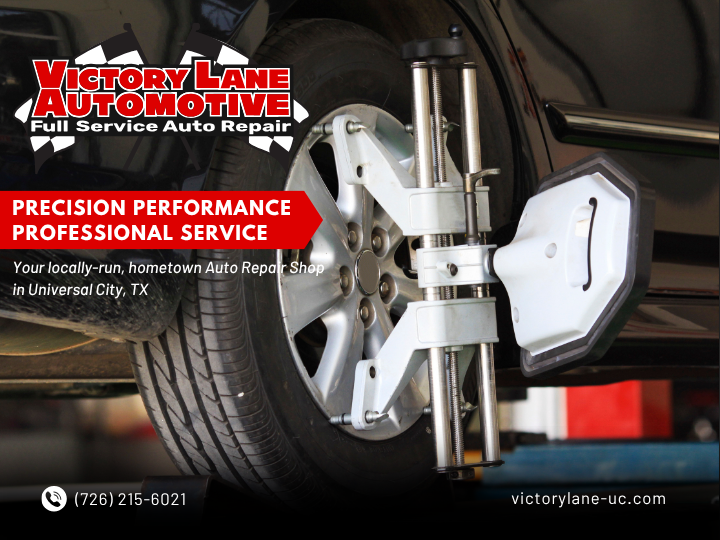
Alignment and suspension concerns can shorten tire life.
When a vehicle is out of alignment, the tires may scrub against the road instead of rolling evenly. A worn suspension component can allow unwanted movement that changes how the tire contacts the pavement.
Possible warning signs include:
- The vehicle pulling to one side
- An off-center steering wheel
- Uneven tire wear
- Steering vibration
- Increased road noise
- Reduced handling confidence
- Frequent tire-pressure changes
Replacing worn tires without correcting the condition that damaged them can allow the same problem to happen again.
Doing the work right the first time means inspecting the entire system. The tires, wheels, alignment, steering, suspension, and brakes should be evaluated together when the symptoms or wear pattern suggest a related concern.
Quick Tip: Look across the full width of each tire rather than checking only the outside edge. Inner-edge wear can be difficult to see without turning the steering wheel or raising the vehicle.
A Local Dealership Alternative in Universal City
This is where Victory Lane Automotive can provide an important dealership alternative for drivers in Universal City and surrounding Bexar County communities.
Located at 264 Kitty Hawk Road, Victory Lane Automotive provides automotive diagnostics, air-conditioning service, brake repair, belt and hose service, oil and filter service, steering and suspension repair, wheel alignment, and other maintenance and repair services. Its technicians service numerous vehicle makes and models, including passenger cars, trucks, minivans, and SUVs.
The shop’s service area includes Universal City, Schertz, Converse, Live Oak, Selma, Cibolo, San Antonio, and surrounding communities.
One of the most meaningful advantages of working with a local repair shop is continuity.
When the same shop cares for a vehicle over time, the repair team can become familiar with its service history, previous recommendations, developing concerns, and the owner’s driving habits.
Instead of beginning from the start at every appointment, the shop can build on what was learned during previous visits.
That history can help the repair team:
- Recognize repeated concerns
- Track developing wear
- Avoid duplicating completed services
- Plan upcoming maintenance
- Compare current inspection results with previous findings
- Identify changes before they become larger problems
- Help the owner prepare for future vehicle needs
A continuing relationship can also create greater accountability. The people making the recommendation are likely to see the customer again. They understand that the quality of their work and communication will affect the long-term relationship.
The goal should never be to sell every service that could possibly be performed. The goal should be to inspect carefully, diagnose accurately, explain honestly, prioritize intelligently, and help the owner make the best decision for the vehicle.
That is what it means to truly have the customer’s best interest at heart.
Auto Repair for Universal City and Nearby Communities
Victory Lane Automotive serves drivers in Universal City and nearby communities such as Schertz, Converse, Live Oak, Selma, Cibolo, Kirby, Windcrest, Garden Ridge, New Braunfels, and the greater San Antonio area.
Drivers throughout this region may experience:
- Short local trips
- Highway commuting
- Stop-and-go traffic
- Extended idling
- Construction zones
- Hot summer temperatures
- Heavy air-conditioning use
- Sudden thunderstorms
- Standing water
- Potholes and road debris
- Long-distance regional travel
These conditions affect vehicles in different ways.
Frequent stopping creates repeated heat cycles in the brakes. Rough roads can affect tires, wheels, steering, suspension, and alignment. Short trips can allow moisture and contamination to remain in fluids. Heat can expose weaknesses in batteries, cooling systems, air-conditioning components, belts, hoses, tires, and electrical systems.
Extended idling also creates engine operating time even though the odometer is not increasing.
That is why professional maintenance should consider both time and mileage.
A low-mileage vehicle may still need attention because fluids, rubber components, batteries, seals, and tires can deteriorate with age and exposure.
A professional repair shop should not simply look at the odometer and make a generic recommendation. It should consider how the vehicle is actually being driven.
Routine Inspections Help Prevent Larger Problems
Many vehicle problems do not immediately activate a dashboard warning light.
A vehicle can have uneven tire wear, worn brake components, loose suspension parts, fluid leaks, deteriorating belts, damaged hoses, a weak battery, or alignment problems without triggering a warning.
Routine inspections help identify these concerns before they create a breakdown or damage another component.
A professional inspection should not be used to frighten the customer. It should be used to educate the customer.
The shop should explain:
- What is in good condition
- What requires immediate attention
- What should be planned soon
- What can be monitored
This allows the owner to prepare instead of being surprised.
Early identification can also reduce the total cost of vehicle ownership.
A minor fluid leak can be documented before it damages another part. Uneven tire wear can reveal an alignment or suspension concern before an entire set of tires is affected. A weak battery can be identified before the vehicle fails to start.
The customer benefits when inspection findings are used to create a long-term plan rather than a high-pressure sales presentation.
Quick Tip: Do not wait for a dashboard light to request an inspection. Tires, brakes, steering, suspension, belts, hoses, fluid leaks, and alignment concerns may develop without immediately triggering one.
Preventive Maintenance Is Part of Doing the Job Right
Preventive maintenance is not about replacing fluids or components without a reason. It is about reducing avoidable wear, supporting reliability, and identifying developing concerns before they become larger problems.
For many drivers, a strong maintenance plan begins with oil service and a complete vehicle inspection every 5,000 miles.
That regular interval gives the repair team an opportunity to evaluate:
- Tires and tire pressure
- Brakes
- Fluid levels and condition
- Belts and hoses
- Battery condition
- Steering components
- Suspension components
- Exterior lights
- Windshield wipers
- Filters
- Visible leaks
- Developing wear
Time also matters.
A vehicle that travels relatively few miles may still need maintenance because fluids absorb contamination, rubber deteriorates, batteries weaken, and tires age.
A professional repair shop should evaluate the vehicle based on time, mileage, current condition, and actual driving habits.
The objective is not to create unnecessary services. It is to help the customer understand the vehicle well enough to prevent avoidable failures.
When the Dealership May Still Be Necessary
A trustworthy independent repair shop should be willing to recommend the dealership when the dealership is genuinely the appropriate resource.
Examples may include:
- Manufacturer recalls
- Certain factory warranty repairs
- Restricted security procedures
- Manufacturer-specific campaigns
- Some software or programming functions
- Specialized equipment unavailable outside the dealer network
Vehicle owners can use NHTSA’s recall lookup to determine whether a specific vehicle has an open safety recall. NHTSA states that applicable recall repairs are completed without charge through the manufacturer’s dealership network.
The relationship does not need to be dealership versus independent repair shop in every situation.
A customer can use the dealership for services requiring dealer involvement and rely on a qualified local shop for routine maintenance, diagnostics, inspections, brakes, steering, suspension, electrical concerns, cooling-system service, air conditioning, and general repairs.
A shop that truly has the customer’s best interest at heart should never allow pride to interfere with giving the correct recommendation.
When another facility is better equipped for a specific procedure, the honest response is to explain that clearly.
That kind of transparency builds trust.
Questions to Ask Before Authorizing Auto Repair
Customers do not need to become automotive experts to make better repair decisions.
They simply need a repair shop willing to answer reasonable questions.
Before authorizing a repair, ask:
- What testing was performed?
- What evidence confirms the failure?
- Is this a safety issue, reliability concern, maintenance need, or condition to monitor?
- Does the repair correct the cause or only the symptom?
- Are related parts and procedures included?
- What type of replacement part is being used?
- Does the repair require programming, calibration, or alignment?
- How will the completed repair be tested?
- What warranty supports the work?
- What should I expect after the repair?
A professional service advisor should welcome these questions.
The explanation should be understandable and should not depend on fear, pressure, or unnecessary technical language.
Be cautious when:
- A major repair is recommended without testing
- The explanation remains vague
- Every recommendation is presented as an emergency
- The same concern returns repeatedly
- Parts are replaced without a confirmed diagnosis
- The shop cannot explain how the completed repair will be verified
- The customer is discouraged from asking questions
- The estimate does not clearly explain what is included
Quick Tip: At pickup, ask, “How did you confirm that my original concern was corrected?” The answer reveals a great deal about the shop’s repair process.
Verification Is What Completes the Repair
Installing a replacement part does not automatically mean the repair is complete.
The result must be verified.
Depending on the concern, verification may include:
- Restarting and operating the system
- Checking for leaks
- Rechecking fluid levels
- Clearing and rescanning diagnostic codes
- Reviewing live operating data
- Completing a road test
- Confirming that a noise is gone
- Checking braking performance
- Verifying steering response
- Measuring charging-system operation
- Testing air-conditioning performance
- Completing alignment measurements
- Performing required relearn or calibration procedures
The original customer concern should guide the final check.
When the vehicle arrives because of a vibration, the shop should determine whether the vibration has been corrected. When it arrives with a warning light, the system should be rescanned and tested. When the concern involves overheating, the cooling system should be operated and checked under the appropriate conditions.
Verification is what turns completed labor into a completed repair.
The Best Repair Value Is the Correct Result
The lowest starting estimate is not always the lowest-cost outcome.
A repair that does not correct the concern can lead to repeated appointments, additional parts, more labor, towing, transportation difficulties, lost time, and further vehicle damage.
The highest estimate does not automatically guarantee the best repair either.
True value comes from receiving:
- An accurate diagnosis
- A complete explanation
- Proper prioritization
- Quality replacement parts
- A complete repair procedure
- Skilled installation
- Final verification
- Dependable warranty support
- Accurate service records
- A practical long-term vehicle plan
A professional shop protects the customer by testing before replacing. It reduces repeat visits by following the complete repair procedure. It helps prevent breakdowns by identifying concerns early. It respects the customer’s time by communicating clearly.
That is what a dealership alternative should provide.
The customer should not have to choose between technical ability and personal service. A qualified independent repair shop should deliver both.
Choose a Universal City Repair Shop That Puts the Customer First
Drivers searching for dealership alternative auto repair in Universal City, Texas, should look beyond the name on the building.
The right shop will listen before recommending, test before replacing, explain before requesting authorization, complete the entire repair procedure, and verify the result before returning the vehicle.
That process protects the customer from the additional cost of incorrect diagnoses, incomplete repairs, unnecessary parts, and repeated visits.
It also creates something equally important: confidence.
The customer should understand the vehicle’s condition, why the repair is recommended, what needs to happen first, and what can be planned for the future.
Victory Lane Automotive serves Universal City and surrounding San Antonio-area communities from 264 Kitty Hawk Road, Universal City, TX 78148.
For professional diagnostics, vehicle maintenance, brake service Antonio-area communities from 264 Kitty Hawk Road, Universal City, TX 781, steering and suspension repair, wheel alignments, air-conditioning service, and dealership alternative auto repair, call (726) 222-1264 or visit Victory Lane Automotive online.
The objective is simple: diagnose accurately, communicate honestly, complete the work properly, and help every customer make the best decision for the vehicle.
That is what it means to truly have the customer’s best interest at heart.
You can watch the video