First time taking my car to a mechanic what to expect
First time taking my car to a mechanic what to expect

What to Expect the First Time You Take Your Car to a Mechanic in Universal City — And Why Doing It Right the First Time Costs Less Than You Think
There is a specific kind of nervousness that comes with handing your car keys to a stranger. You are trusting someone with a machine you depend on, a machine you may not fully understand, and you have no easy way to know whether the person behind the counter is telling you the truth. If this is your first time taking a vehicle to a professional shop — maybe you just bought your first car, maybe you just PCS'd to the Randolph area and left your old mechanic behind, or maybe you have been getting by on quick lube stops and a friend's garage — that nervousness is normal. It does not mean you are naive. It means you are paying attention.
This guide is written to take the mystery out of that first visit. Not to sell you anything, and not to scare you, but to help you walk in prepared, ask the right questions, and understand what is actually happening from the moment you pull into the lot on Kitty Hawk Road to the moment you drive back out toward Live Oak, Schertz, or wherever home happens to be. And along the way, we are going to talk honestly about a hard truth that costs Greater San Antonio drivers real money every year: the work you skip, delay, or hand to the cheapest available option almost always ends up costing more than having it done right the first time by a professional shop that stands behind its work.
Let's walk through it together.
Why the First Visit Feels So Intimidating — and Why It Shouldn't
Most of the fear around visiting a mechanic comes down to information imbalance. The shop knows cars. You may not. That gap can make you feel like you are at a disadvantage before the conversation even starts.
But here is the reframe that changes everything: a good shop does not want that imbalance to exist. A professional, customer-first repair facility makes its money over years, not over a single inflated invoice. Their entire business model depends on you coming back, trusting them, and telling your neighbors around Universal City and out toward Selma that they treated you fairly. In a community built around Randolph, where families come and go on orders and word travels fast, that reputation is everything. That is a completely different incentive than a place trying to squeeze one big ticket out of a stranger they never expect to see again.
So the first thing to understand is this: the right shop is on your side. Your job on that first visit is simply to figure out whether the shop you chose is one of the right ones. And that is far easier to do than diagnosing a transmission.
Quick Tip: Before you ever drop off your car, look at its online reviews specifically for comments about communication — not just price. The single best predictor of a good repair experience is whether the shop explains things clearly and gets your approval before doing work. Price complaints are common everywhere; consistent praise for honesty and clear explanations is the signal you want.
Before You Go: What to Prepare
You do not need to become an amateur technician. But a little preparation makes the whole visit smoother and helps the shop help you.
First, pay attention to the symptom, not the diagnosis. It is tempting to walk in and announce "I think it's my alternator" because something online told you so. Resist that. Instead, describe what you actually experience: "There's a grinding noise when I brake, mostly when I'm slowing down coming off I-35." "The car shakes at highway speed out on Loop 1604." "There's a smell like something's burning after I've been crawling down Pat Booker Road for a while." Technicians are trained to work backward from symptoms to causes. When you hand them a guess instead of a symptom, you sometimes send them down the wrong road — and that can cost you time and money.
Second, note when it happens. Cold starts? After the car warms up? Only when turning? Only after sitting in the brutal Texas summer sun all day? Intermittent problems are the hardest to catch, and the more detail you provide, the better the odds the shop finds it on the first try instead of asking you to leave it another day.
Third, bring your history if you have it. Even a shoebox of old receipts or a note in your phone about your last oil change helps. If you are new to the area — and around here, plenty of people are, thanks to Randolph — and this is your first visit anywhere near Universal City, just say so. A good service advisor will build a baseline for your vehicle from scratch.
Quick Tip: Take a 15-second video on your phone of the noise, the dashboard light, or the leak in your driveway. Intermittent issues have a way of disappearing the moment a technician gets in the car. Video evidence saves you from the frustrating "well, it's not doing it now" conversation.
Walking In: The Check-In Process, Step by Step
Here is what a professional visit actually looks like, so nothing catches you off guard.
The write-up. A service advisor greets you and asks about the vehicle and the reason for your visit. This is where all that preparation pays off. They will write up your concerns, get your contact information, and confirm how you want to be reached. Pay attention here — a good advisor listens and asks follow-up questions rather than rushing you.
The authorization to diagnose. Many people are surprised by this step. A shop cannot always tell you what is wrong just by looking. Diagnosis often takes time, tools, and expertise, and reputable shops charge for it because that expertise has value. You may be asked to approve a diagnostic fee before they begin. This is normal and, honestly, a good sign. A shop that promises a free diagnosis on a complex problem sometimes makes up for it by steering you toward unnecessary repairs. Paying a fair diagnostic fee to know the truth is one of the best deals in car ownership.
The inspection. Good shops perform a thorough inspection, often documenting the condition of major systems with notes and sometimes photos. This is not a scheme to find extra work. Your car is an interconnected system, and a technician who spots a cracked belt or a leaking seal while they have your vehicle on the lift is doing you a favor by telling you now rather than letting you get stranded on I-35 in triple-digit heat later.
The call. Before doing repair work beyond the agreed diagnostic, a professional shop calls you with findings and a clear estimate. Nothing major should happen without your approval. This is your right as a customer and a legal expectation in Texas. If a shop does significant work you never authorized, that is a serious red flag.
Quick Tip: When the shop calls with the estimate, it is completely acceptable to ask, "Which of these needs to happen now for safety, and which can wait?" A trustworthy advisor will answer honestly and help you prioritize. Watch how they respond — a customer-first shop welcomes that question. A pushy one gets vague.
Understanding the Estimate: What All Those Line Items Mean
The estimate is where a lot of first-timers freeze up. Let's decode it.
An estimate typically separates parts and labor. Labor is usually calculated using standardized labor times — industry references that tell the shop roughly how long a given job should take. This is actually good for you, because it means you are not billed based on how slow or fast one particular technician happens to be. The shop quotes the standard time, and that is what you pay even if the job runs long.
Parts may come in different tiers. There are original equipment parts, quality aftermarket parts, and cheaper economy parts. A good advisor will talk with you about the trade-offs rather than silently defaulting to the most expensive option or the cheapest. Cheaper is not always the bargain it appears to be, which brings us to the heart of this article.
The Real Cost of Cutting Corners: Why "Right the First Time" Wins
Here is where we get honest about the true cost of a repair, without making this about a price tag at all — because it is really about your safety, your time, and your peace of mind.
There is a powerful temptation, especially on your first visit, to chase the lowest number. To take the coupon at the chain quick-lube. To let a neighbor's cousin do it in a driveway. To decline the repair the shop recommends and "keep an eye on it." Sometimes that works out. Often, it does not — and when it doesn't, the bill for doing it wrong is dramatically higher than the bill for doing it right would have been.
Consider a few common examples that play out in shops across the Universal City area every week.
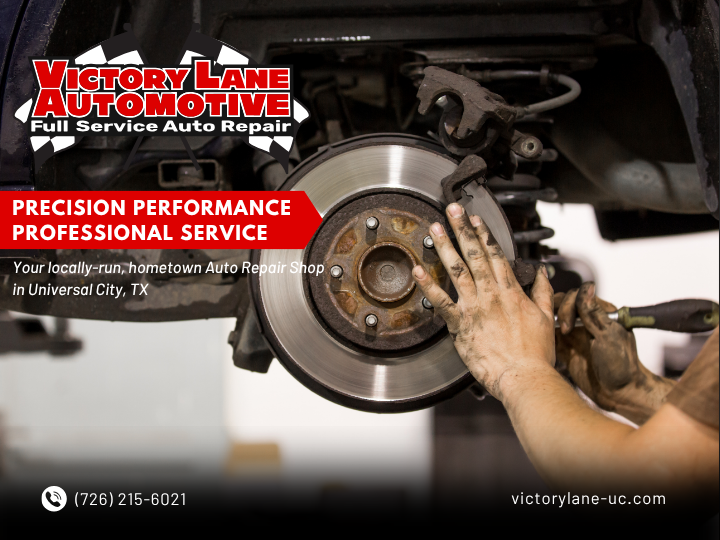
The brake job that turned into a rotor-and-caliper job. A driver notices squeaking. A budget shop or a rushed job slaps on the cheapest pads to hit a price point and skips resurfacing or replacing worn rotors. Within months, the cheap pads wear unevenly, chew into the rotors, and now what could have been a straightforward pad-and-rotor service becomes pads, rotors, and possibly a seized caliper. The "savings" evaporated, and the driver paid twice — once for the cheap job, once for the real one. Between the I-35 and Loop 1604 commutes and the stop-and-go on Pat Booker Road, brakes here work hard. This is not the system to cut corners on.
The oil change that became an engine. Someone stretches an oil change thousands of miles past due because money is tight, or lets a place use the wrong-spec oil to save a few dollars. Oil is the lifeblood of an engine. Run it too long or use the wrong type, and you accelerate wear on components that cost far more to repair or replace. A proper oil service is one of the least expensive things you will ever do for your car. Skipping it is one of the most expensive. On this point, real maintenance is not about blindly following a sticker in your windshield or a generic interval — it is about how your car is actually driven, in your conditions. The brutal South Texas heat, long idles in traffic with the A/C blasting, short trips around the neighborhood that never let the engine fully warm, the highway pulls down to San Antonio or up toward New Braunfels — all of that shapes the real-world life of your oil. Heat is especially hard on a vehicle, and a professional who knows your driving reality gives you better guidance than any one-size-fits-all chart.
The "I'll just live with it" leak. A small coolant or oil leak gets ignored because the car still runs fine. Then one 100-degree afternoon stuck in traffic, the engine overheats, a head gasket goes, and a repair that would have been minor becomes one of the largest bills a car owner ever faces. In the South Texas heat, cooling-system problems are especially unforgiving. The leak was talking. Nobody listened.
The pattern is always the same. The cheap option addresses the symptom, not the cause. It uses inferior parts, skips necessary related work, or defers the problem. And deferred car problems do not stay the same size. They grow. Mechanical issues compound, because everything in a vehicle is connected. A worn part stresses the parts around it. A small failure becomes a cascade.
Quick Tip: When you are weighing whether to do a repair now or wait, ask yourself one question: "Is this problem going to get cheaper if I ignore it?" With car repairs, the answer is almost never yes. The clock is not on your side, and neither is the summer heat or the daily miles.
What "Doing It Right" Actually Buys You
When a professional shop does the job right the first time, you are not just paying for parts and labor. You are getting things that the cheap alternative cannot provide.
You are getting the correct diagnosis, so you fix the actual problem instead of throwing money at a guess.
You are getting quality parts and proper procedure, so the repair lasts instead of failing again in six months.
You are getting a warranty. Reputable shops stand behind their work with meaningful guarantees. If something they repaired fails within the warranty period, they make it right. The driveway job comes with no such promise — when it fails, you start over from zero.
You are getting a documented history, which matters enormously when you eventually sell the car and even more if the vehicle is still under a manufacturer's warranty, where proper service records protect your coverage. For military families who move often, a clean, documented service history is worth its weight when it comes time to sell before the next PCS.
You are getting safety. Your brakes, your steering, your tires, your suspension — these are not areas where the cheapest option is ever worth it. You share the roads around Universal City with your family, your neighbors, and thousands of commuters moving through the northeast San Antonio metro every day. Done-right work is how you make sure the car stops when you need it to stop.
And you are getting your time and your sanity back. A repair done right once is a repair you never think about again. A repair done cheap is a repair you revisit, reschedule around, and worry over.
How to Tell You've Found a Shop You Can Trust
Since the entire goal of your first visit is to find a shop worth returning to, here is what to look for.
They explain, they don't just tell. A trustworthy advisor helps you understand why a repair is needed, ideally showing you the worn part or the inspection findings. Education is a hallmark of a customer-first shop.
They prioritize honestly. They tell you what is urgent and what can wait, and they do not treat every item as an emergency.
They get your authorization before doing work and never surprise you with charges you didn't approve.
They stand behind their work with a clear warranty they'll explain without you having to pry it out of them.
They welcome your questions rather than making you feel foolish for asking. There are no dumb questions about your own car. A shop that makes you feel small is telling you exactly who they are.
They are consistent. The same care on a small oil change as on a major repair. How a shop treats you when there is little on the table tells you everything about how they will treat you when there is a lot.
Quick Tip: After your first visit, ask yourself whether you understood what you paid for and why. If the answer is yes, you have probably found your shop. Clarity is not a courtesy — it is the whole product. A shop that leaves you informed and confident has earned the next visit.
Serving Universal City and the Surrounding Communities
Victory Lane Automotive sits on Kitty Hawk Road in Universal City, right by Joint Base San Antonio-Randolph and convenient to Live Oak, Schertz, Selma, Converse, Cibolo, Windcrest, and the wider northeast San Antonio metro. With I-35 and Loop 1604 meeting just west of town and Pat Booker Road (SH-218) running right through the community, drivers from across the Randolph area and greater San Antonio can reach the shop easily. Whether your daily driving means commuting down I-35 to San Antonio, running the tri-city errands along Pat Booker Road, or keeping a family vehicle road-ready between assignments, the vehicle you rely on deserves care built around how you actually drive it — not a generic checklist and not a race to the lowest possible price.
The Bottom Line for Your First Visit
Walking into a mechanic's shop for the first time does not have to feel like walking into the unknown. Come prepared with clear symptoms. Expect a diagnostic process that respects both your car and your intelligence. Read the estimate as a conversation, not a verdict. Ask which work is urgent and which can wait. And above all, resist the false economy of the cheapest option, because in the world of auto repair, cheap and expensive are almost always the same bill — just paid at different times.
The shop that does it right the first time is not the one that costs you more. It is the one that saves you from paying twice. Find that shop, build a relationship with it, and one of the most stressful parts of car ownership quietly becomes one of the simplest.
Your first visit is not just a repair. It is the beginning of knowing you are taken care of. That peace of mind is worth more than any coupon.
You can watch the video