Rough Idle Diagnosis and Repair Near Me
Rough Idle Diagnosis and Repair Near Me

Rough Idle Diagnosis and Repair Near Me: Why the First Attempt Should Be the Right One
There is a moment familiar to almost every driver in the northeast San Antonio corridor. You are stopped at a light on Kitty Hawk Road, or waiting to turn onto Pat Booker Road, and the vehicle underneath you starts to shudder. Not violently. Not enough to alarm anyone else in traffic. Just enough that you feel it through the seat and the steering wheel, and you think to yourself, that's new.
A rough idle is one of the most common complaints a vehicle can present, and one of the most misunderstood. It is easy to dismiss because the car still drives. It is easy to postpone because it does not leave you stranded. And it is easy to guess at, because the internet is full of confident voices telling you it is probably one thing, and that one thing is probably simple.
That last part is where the trouble usually begins.
This paper is written for drivers in Universal City, Schertz, Selma, Live Oak, Converse, Cibolo, Randolph AFB, Garden Ridge, Windcrest, and the surrounding communities of Bexar, Guadalupe, and Comal County who are trying to make a good decision about a vehicle that is not idling right. It is not written to sell you anything. It is written to help you understand what a rough idle actually is, what a real diagnosis looks like, and why the path that appears simplest at the start is so frequently the most costly one by the end.
What a Rough Idle Actually Is
Your engine at idle is doing something remarkable and delicate. With no load on it, no acceleration demand, and no help from momentum, it is sustaining combustion on the smallest possible amount of fuel and air, at the slowest speed it can manage while still turning smoothly. Everything has to be right. The air has to be metered correctly. The fuel has to be atomized properly. The spark has to arrive at the exact right instant. The valves have to seal. The engine has to hold vacuum. The computer has to be receiving accurate information from every sensor feeding it.
At highway speed, the engine has enough momentum and enough combustion events per second to smooth over small imperfections. You may never feel a problem at 70 mph on I-35 or Loop 1604. At idle, there is nothing to hide behind. Every flaw shows up as vibration, hesitation, or that uneven pulsing sensation you feel at a stoplight.
This is why a rough idle is so diagnostically valuable. It is the engine telling you, in the most honest way it can, that something in the combustion equation is off. The symptom is small. What it is pointing at may not be.
South Central Texas adds its own stresses. Summers that run over 100 degrees for weeks punish batteries, rubber, plastic, and underhood electronics harder than most drivers appreciate, and heat is the single largest factor in premature battery failure here. Air conditioning runs at maximum load most of the year, which puts additional demand on the engine precisely when it is idling in traffic. Hill Country dust and caliche loads air filtration faster than expected. And the stop-and-go on Pat Booker Road, FM 78, and the I-35 frontage roads means an unusual share of engine hours are spent at idle, which is exactly the condition that does not clear deposits or fully heat exhaust components.
Quick Tip: Pay attention to when the rough idle happens. Cold start only? Warm engine only? In gear but not in park? With the air conditioning running at full blast? These distinctions matter enormously to a technician and cost you nothing to observe. Write them down before your appointment.
The Long List of Things It Could Be
Here is where the honest conversation has to start. A rough idle does not have one cause. It has dozens. And many of them produce nearly identical symptoms.
Ignition system issues. Worn spark plugs, failing ignition coils, degraded plug wires on older vehicles. A single weak coil can cause a misfire that presents as a rough idle and nothing else. Sustained underhood heat is hard on coils and accelerates their decline.
Fuel delivery problems. Clogged or leaking fuel injectors, weak fuel pump pressure, a restricted fuel filter. Direct-injection engines add another layer, since carbon buildup on intake valves is common and produces exactly this symptom. Short trips and heavy traffic accelerate that buildup considerably.
Vacuum leaks. A cracked intake hose, a failed PCV valve, a leaking intake manifold gasket, a brittle vacuum line that finally split after years of Texas heat cycling. Unmetered air entering the engine throws off the air-fuel ratio, and at idle that imbalance is at its most pronounced.
Airflow and throttle issues. A contaminated mass airflow sensor, a dirty throttle body, a failing idle air control valve on older systems, a throttle position sensor giving inconsistent readings. Dusty conditions make intake contamination a more frequent finding here than most drivers realize.
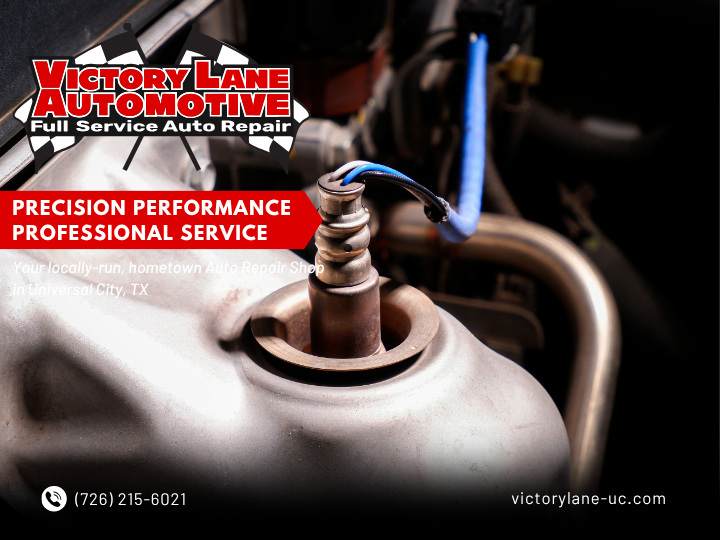
Sensor failures. Oxygen sensors, coolant temperature sensors, camshaft and crankshaft position sensors. A sensor does not have to fail completely to cause problems. A sensor reporting plausible but wrong data is often harder to catch than one that has died outright.
Exhaust restrictions. A partially clogged catalytic converter creates backpressure that disrupts the engine's ability to breathe, and idle is where that shows up first.
Mechanical problems. Low compression in one or more cylinders, a burned valve, worn valve guides, a stretched timing chain that has altered valve timing, a failing engine mount that transmits normal engine vibration into the cabin and mimics a rough idle convincingly.
Electrical and grounding issues. Corroded grounds, a failing battery or alternator, damaged wiring in a connector that only misbehaves under certain conditions. In a climate this hard on batteries and charging systems, this category deserves more attention than it typically receives.
Software and calibration. Some vehicles have known issues resolved by manufacturer reprogramming. No part needs replacing at all.
Read that list again and notice something. Several of those causes are simple. Several are significant. And from the driver's seat, they feel the same.
That is the entire problem with guessing.
The Parts Cannon and What It Actually Costs
There is a phrase technicians use for what happens when someone tries to fix a problem by replacing parts until the symptom goes away. They call it firing the parts cannon.
It happens in home garages and it happens in shops that do not invest in diagnostic capability. The logic feels reasonable: the symptom points toward a few common culprits, so replace the common culprits and see what happens. Start with plugs. Then maybe coils. Then maybe a mass airflow sensor. Then clean the throttle body. Then a fuel injector cleaner. Then a new PCV valve.
Here is why this approach fails so often and so expensively.
Every replaced part that was not the problem is a total loss. Not partially wasted. Entirely wasted. Parts installed on a running vehicle are typically not returnable, and even when they are, the labor to install and remove them is gone. You have paid full price for something that changed nothing.
Multiple simultaneous changes destroy your ability to learn anything. If you replace four things at once and the idle improves, you have no idea which one mattered. If it does not improve, you have eliminated four possibilities at maximum cost and learned almost nothing about the remaining twenty.
A wrong repair can create a new problem. Over-torqued spark plugs damage cylinder head threads. Aggressive throttle body cleaning can damage coatings on electronically controlled throttle bodies. Disconnected sensors can trigger cascading fault codes. Improperly seated intake components create the very vacuum leaks you were trying to eliminate.
The underlying cause keeps working while you chase symptoms. This is the most expensive part. If the real issue is a lean condition caused by a vacuum leak, every day you drive with it is a day your engine is running hotter than designed, in a climate that already runs it hot. If the real issue is a misfire, every day is a day raw fuel is washing down a cylinder wall and loading up a catalytic converter. A misfire ignored long enough turns a modest ignition repair into catalytic converter replacement. A lean condition ignored long enough damages valves and pistons.
Quick Tip: If your check engine light is flashing rather than steady, stop driving and get the vehicle towed. A flashing light indicates an active misfire severe enough to damage the catalytic converter, and every mile you drive makes the eventual repair larger.
What Real Diagnosis Looks Like
There is a persistent belief that diagnosis means plugging in a code reader. It does not. A code reader tells you which circuit or system reported a fault. It does not tell you why.
Consider a code indicating a cylinder three misfire. That code does not say the coil is bad. It says cylinder three is not producing the combustion event the computer expected. The cause could be the coil, the plug, the injector, a vacuum leak localized to that runner, low compression in that cylinder, a wiring fault, or a computer driver circuit. A code reader narrows the field. It does not answer the question.
Professional diagnosis is a structured process:
Verify the concern. The technician drives the vehicle and confirms the symptom exists as described, under the conditions described. You cannot fix what you cannot reproduce.
Gather the full picture. Not just active codes, but pending codes, history codes, freeze frame data showing engine conditions at the moment of the fault, and live data streams showing what every relevant sensor is reporting in real time.
Analyze the data against known-good values. This is where experience and technical information systems matter. A technician needs to know what fuel trim numbers should look like on this specific engine, what the expected vacuum reading is, what normal misfire counts look like. Deviation from known-good is where the answer lives.
Test, do not assume. Vacuum leak suspected? Smoke test the intake system and find it. Fuel delivery suspected? Measure actual fuel pressure under load, not at rest. Ignition suspected? Scope the primary and secondary ignition waveforms and see what the coil is actually doing. Compression suspected? Run a relative compression test or a cylinder leak-down test.
Isolate to a specific failed component. Not a system. A component. "The problem is in the fuel system" is not a diagnosis. "Injector four has a resistance reading outside specification and shows a degraded spray pattern" is a diagnosis.
Verify the repair. After the work, the technician confirms the symptom is gone, the data has returned to normal ranges, and no new issues have been introduced.
That process takes time. It requires equipment that costs more than most people's vehicles. It requires subscriptions to manufacturer technical databases. It requires a technician who has invested years in learning to interpret what the equipment shows. That is what you are paying for when you pay for diagnosis, and it is the single highest-value expenditure in the entire repair.
Quick Tip: When a shop explains a diagnostic finding to you, ask them to show you the data. A shop confident in its diagnosis will happily walk you through the scan tool readings, the smoke test results, or the waveform. Transparency is a strong signal of competence.
The Hidden Costs Nobody Adds Up
When people compare doing it themselves against going to the cheapest option available, they usually compare parts prices. That comparison leaves out most of the real cost.
Your time has value. A weekend spent under the hood in triple-digit heat, plus a trip to the parts store, plus a second trip because the first part was wrong, plus research time, plus the frustration. That is not free.
Repeat repairs compound. The most common outcome of a guessed repair is not total failure. It is partial improvement that fades. The idle smooths out for two weeks, then returns. Now you are back where you started, minus everything already spent.
Diagnostic difficulty increases after failed attempts. When a vehicle arrives with six recently replaced parts and a modified electrical connector, the technician now has to determine what was original, what was changed, whether anything was installed incorrectly, and whether any of those changes introduced new faults. Undoing a previous attempt takes time, and time is the cost.
Secondary damage is the expensive part. This deserves emphasis because it is where the real financial difference lives. An unresolved misfire loading a catalytic converter turns an ignition repair into an emissions system repair. A lean condition running long enough overheats exhaust valves. A failing sensor causing improper fuel trim washes oil off cylinder walls and accelerates ring wear. Every one of these transformations takes a bounded problem and makes it an unbounded one.
Fuel economy losses accumulate quietly. A vehicle running with incorrect fuel trim burns more fuel every mile. Over months of commuting on I-35, Loop 1604, and FM 78, that adds up invisibly.
Inspection requirements. Texas requires annual vehicle inspection, and Bexar County vehicles are subject to emissions testing as part of it. An illuminated check engine light or unresolved fault codes means a failed test, and incomplete readiness monitors fail as well, so clearing codes right before an inspection does not work either. Now the repair is not optional and not on your schedule.
Resale and reliability. A vehicle with a documented history of proper repair holds value. A vehicle with a history of recurring unresolved symptoms does not, and neither does your confidence in it on a 102-degree August afternoon with the air conditioning fighting for its life.
Why the Cheapest Estimate Is Frequently the Most Expensive Path
Here is an uncomfortable truth worth stating plainly.
When one shop quotes significantly less than another for the same complaint, it is rarely because they found efficiency the other missed. It is usually because they are quoting a different job. One is quoting a diagnosis followed by a targeted repair. The other is quoting a common-cause replacement based on the symptom description, without confirming that common cause applies to your vehicle.
If the guess is right, you saved something. If the guess is wrong, you have paid for a repair that did not fix your problem, and you still have to pay someone to actually find it.
The cheap estimate is a bet. Sometimes bets pay off. But you should know you are making one.
There is a related pattern worth naming. Some shops do not charge for diagnosis at all, then recover that cost by recommending broader repairs than the situation requires. You did not pay for the diagnosis directly. You paid for it in the repair order. A shop that charges honestly for diagnostic time and then recommends only what the diagnosis supports is frequently the better value, even when the initial number is higher.
Quick Tip: Ask a prospective shop this exact question: "What is your process for diagnosing a rough idle?" A shop that answers with a structured process is showing you how they think. A shop that answers by naming a part is guessing before they have seen the vehicle.
What Actually Serves Your Interest
If you take nothing else from this paper, take this framework for evaluating any shop you are considering.
They diagnose before they recommend. No competent technician can tell you what is wrong over the phone. If someone does, they are guessing, and you are the one absorbing the risk of that guess.
They explain findings in terms you can follow. Not condescension, not jargon as a shield. A clear explanation of what they found, how they found it, and what happens if it goes unaddressed.
They separate urgent from monitorable. Not everything found during a proper inspection needs attention today. A shop acting in your interest tells you what is safety-critical, what is deteriorating and should be planned for, and what is simply worth watching. That distinction respects both your safety and your budget.
They stand behind the work. A meaningful warranty on parts and labor is a shop putting its own money behind its diagnosis. Shops that guess cannot afford to offer strong warranties, because guesses come back.
They document. Written findings, test results, and a clear record of what was done and why. This protects you and builds a service history that follows the vehicle.
They tell you when the answer is no. Sometimes the honest answer is that the vehicle is not worth the repair, or that the symptom is normal for that engine design, or that the customer should wait and monitor. A shop willing to talk itself out of work is a shop you can trust with the work it does take.
Practical Guidance Before Your Appointment
You can meaningfully improve the accuracy and efficiency of your diagnosis by preparing well.
Note the conditions precisely. Cold start or warm engine. Park, neutral, or in gear. Air conditioning on or off, since AC load at idle changes the picture significantly. After sitting overnight or after a highway run. Does it improve after a few minutes or stay constant?
Note when it started and what else changed. Recent fuel fill-up. Recent service. The first stretch of triple-digit heat. A rough section of road on Kitty Hawk Road or Pat Booker Road. Anything that coincided.
Note any other symptoms. Reduced power. Hesitation on acceleration. Unusual smells. Changes in fuel economy. Warning lights, including ones that came and went.
Do not clear the codes. Freeze frame data captured at the moment of the fault is diagnostically valuable, and clearing codes erases it. If the light is on, leave it on. Clearing codes also resets readiness monitors, which will hold up your state inspection.
Bring your records. Knowing what was recently replaced saves diagnostic time and prevents duplicate work.
Be honest about prior attempts. If you already replaced parts, say so. It is not a judgment. It is information the technician needs.
Quick Tip: If the rough idle comes and goes, try to get the vehicle to the shop while the symptom is present. An intermittent fault that will not reproduce is dramatically harder to diagnose, and a vehicle behaving badly on arrival is a gift to the technician.
The Underlying Principle
A rough idle is a message. It is the engine communicating that one of the many precise conditions required for smooth combustion is no longer being met. The message is quiet. The condition behind it may not be.
The decision you face is not really about how to fix a rough idle. It is about whether you want to find out what is actually wrong, or whether you want to try things until the symptom goes away. Those are different goals, and they lead to different outcomes.
Finding out what is wrong costs something up front and is bounded. Trying things until the symptom goes away costs less at each individual step, has no defined endpoint, and carries the risk that the underlying cause continues doing damage the whole time.
Drivers throughout Universal City, Schertz, Selma, Live Oak, Converse, Cibolo, Randolph AFB, Garden Ridge, and Windcrest face this decision constantly. The vehicles here work hard. Stop-and-go on Pat Booker Road, Kitty Hawk Road, and FM 78, the daily push on I-35 and Loop 1604, air conditioning running at full load most of the year, and summer heat that punishes underhood components combine into an operating environment where idle quality matters and where problems surface early.
Victory Lane Automotive at 264 Kitty Hawk Rd in Universal City approaches rough idle complaints the way the problem deserves to be approached: by finding out what is actually happening before recommending what to do about it. Diagnosis first, explanation second, repair third, verification fourth. Not because it is a slogan, but because it is the only sequence that reliably produces a fixed vehicle and a customer who is not back in three weeks with the same complaint.
If your vehicle is idling roughly, the best thing you can do is stop guessing and start finding out. Call (726) 222-1264 or visit https://www.victorylane-uc.com/ to schedule a proper diagnosis.
The goal was never to replace parts. The goal was always to fix the vehicle.
You can watch the video